
Difference Between POP and Gypsum False Ceiling
When planning interior spaces, ceilings play an important role in enhancing both functionality and aesthetics. False ceilings are widely used in modern homes and commercial interiors to improve lighting, hide wiring, and create decorative designs. One of the most common comparisons homeowners make is the Difference Between POP and Gypsum False Ceiling.
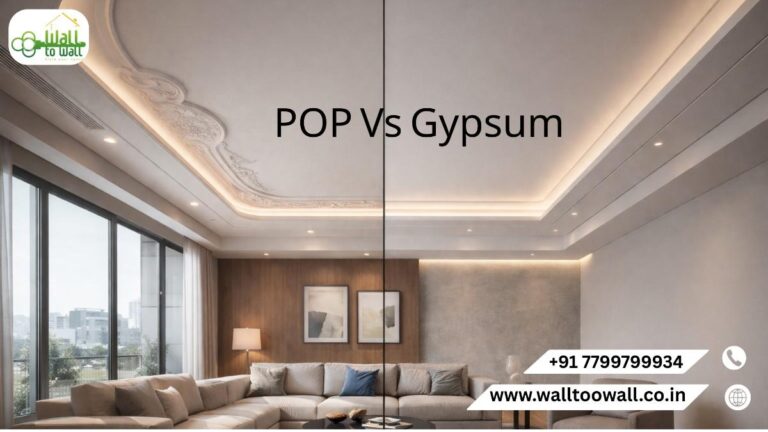
Both materials are widely used for ceiling designs, yet they differ in installation method, durability, cost, maintenance, and design flexibility. Understanding the Difference Between POP and Gypsum False Ceiling helps homeowners and interior planners choose the most suitable material for their space.
False Ceilings
A POP false ceiling is created using Plaster of Paris, a fine white powder derived from gypsum. The powder is heated to remove moisture and then mixed with water to form a paste. This paste is applied to a ceiling framework and molded into different shapes and patterns. Once it dries, it forms a smooth, hard surface suitable for decorative finishes.
POP ceilings are commonly used to design artistic ceiling structures, layered patterns, and customized interior ceiling layouts. Because the material can be shaped easily during installation, it allows designers to create detailed and decorative ceiling styles.
Key Characteristics of POP False Ceiling
Lorem ipsum dolor sit amet, consectetur adipiscing elit. Ut elit tellus, luctus nec ullamcorper mattis, pulvinar dapibus leo
- Applied as a wet plaster mixture and shaped during installation
- Smooth finish after drying and polishing
- Allows decorative patterns and detailed ceiling structures
- Installation time is longer compared to prefabricated ceilings
Due to these characteristics, POP ceilings are widely used in living rooms, bedrooms, and spaces where decorative ceiling designs are preferred.
What Does a Gypsum False Ceiling Mean?
A gypsum false ceiling is constructed using ready-made gypsum boards that are mounted onto a suspended metal framework. These boards are manufactured under controlled factory conditions and then transported to the project site for installation.
Since the boards are prefabricated, gypsum ceilings can be installed quickly compared to traditional plaster-based ceiling systems. The material also provides a smooth surface that can be painted or finished to match the overall interior design.
Key Characteristics of Gypsum False Ceiling
- Manufactured as ready-made gypsum panels
- Installed using suspended metal frameworks
- Lightweight structure that simplifies installation
- Faster completion time compared to POP ceilings
- Creates a clean and consistent ceiling surface
- Limited design flexibility for detailed patterns
Because of these features, gypsum ceilings are widely used in modern residential interiors and office environments.

Difference Between POP and Gypsum False Ceiling in Material Composition
One of the key factors in understanding the Difference Between POP and Gypsum False Ceiling is the material used to create each ceiling system. The composition of these materials affects installation methods, durability, and the final finish of the ceiling.
POP ceilings are made using Plaster of Paris, which is a powdered material derived from gypsum. During installation, the powder is mixed with water to form a paste. This paste is then applied to a ceiling framework and shaped manually to create the desired design. Once it dries, the material forms a hard and smooth surface suitable for painting and decorative finishing.
Gypsum ceilings, in contrast, are made using prefabricated gypsum boards that are produced in factories. These boards are manufactured under controlled conditions and then transported to the installation site. During construction, the boards are fixed to a suspended metal framework to create the false ceiling structure.
Difference Between POP and Gypsum False Ceiling in Installation Process
The installation method is an important aspect when understanding the Difference Between POP and Gypsum False Ceiling. Each ceiling type follows a different construction process, which affects the time required, labor involvement, and overall finishing.
How a POP False Ceiling is Installed
POP ceilings are usually constructed directly at the project site. The plaster mixture is prepared by combining Plaster of Paris powder with water to form a workable paste. This mixture is then applied over a metal framework fixed below the main ceiling. Skilled craftsmen shape and spread the material according to the required ceiling design.
Once the plaster layer dries, additional finishing work such as polishing and smoothing is carried out to achieve a clean and even surface. Because the entire process involves manual application and drying time, POP ceiling installation generally requires more time and experienced labor.
Gypsum Ceiling Installation
Gypsum ceilings follow a different approach because they use ready-made boards. In this process, a metal frame is first installed below the main ceiling to support the gypsum boards. The prefabricated boards are then fixed onto the framework using screws or other fasteners.
After installation, the joints between the boards are sealed and finished with jointing compounds to create a smooth and continuous ceiling surface. Since gypsum boards are manufactured in advance, the installation process is typically quicker and more structured.
Difference Between POP and Gypsum False Ceiling in Design Flexibility
Design flexibility is an important factor when evaluating the Difference Between POP and Gypsum False Ceiling. The ability to create different shapes, patterns, and styles can influence the overall appearance of interior spaces.
POP ceilings offer high design flexibility because the material is applied as a paste during installation. This allows craftsmen to mold it into various shapes and decorative patterns. Curved edges, layered ceiling designs, and detailed decorative elements can be created easily using POP.
Because of this flexibility, POP is often used for decorative ceilings in living rooms, bedrooms, and spaces where customized ceiling designs are preferred.
Gypsum Design Flexibility
Gypsum ceilings are created using prefabricated boards, which are usually flat panels. These boards can be arranged in different patterns or levels, but they have limitations when it comes to creating highly intricate shapes or detailed artistic designs.
Although gypsum ceilings can still support modern and layered ceiling layouts, complex curved structures are more difficult to achieve compared to POP.
Difference Between POP and Gypsum False Ceiling in Durability
Durability is a key consideration when evaluating the Difference Between POP and Gypsum False Ceiling. The lifespan and performance of a ceiling depend on the material structure, installation quality, and maintenance.
POP ceilings can be durable when installed correctly by skilled professionals. The plaster forms a solid and smooth surface once it dries. However, over time, POP ceilings may develop minor cracks if the building structure shifts or if the installation was not done properly. Proper finishing and periodic maintenance help maintain the appearance and strength of POP ceilings.
Gypsum ceilings, on the other hand, are constructed using prefabricated gypsum boards supported by a metal framework. This structure provides stability and reduces the chances of cracking compared to plaster-based ceilings. However, gypsum boards may be affected by prolonged exposure to moisture, which can weaken the material if not protected properly.
Difference Between POP and Gypsum False Ceiling in Maintenance
Maintenance requirements also play a role in understanding the Difference Between POP and Gypsum False Ceiling. The long-term upkeep of a ceiling depends on the material used and the conditions of the interior environment.
POP ceilings may require periodic maintenance over time. Since the material is applied as plaster, small cracks can sometimes appear due to temperature variations, building movement, or natural aging of the material. These cracks are usually minor and can be repaired through patchwork and repainting to restore the ceiling surface.
Gypsum ceilings typically require less maintenance because they are constructed using prefabricated boards fixed to a metal framework. The boards maintain a consistent structure and usually do not develop cracks as frequently as plaster-based ceilings. However, if a gypsum board becomes damaged due to impact or moisture exposure, the affected section may need to be replaced.
Difference Between POP and Gypsum False Ceiling in Cost
Cost is another factor that influences the Difference Between POP and Gypsum False Ceiling.
POP ceilings may require higher labor costs because the installation is done manually on-site and requires skilled craftsmen.
Gypsum ceilings often have predictable costs because the boards are factory-made and installation time is shorter.
Cluster keywords naturally included: false ceiling cost comparison, ceiling installation pricing
However, the final cost depends on design complexity, ceiling area, and finishing materials.
Difference Between POP and Gypsum False Ceiling in Installation Tim
Installation time is another important aspect when comparing the Difference Between POP and Gypsum False Ceiling.
POP ceilings generally take longer because the plaster needs time to be applied, shaped, and dried before finishing.
Gypsum ceilings are quicker to install because the boards are pre-manufactured and only require fixing and joint finishing.
Cluster keywords naturally included: false ceiling installation time, interior ceiling construction
This makes gypsum ceilings a practical option for projects that require faster completion.
Applications of POP False Ceiling
POP ceilings are commonly used in areas where decorative and customized ceiling designs are required.
- Living room ceiling designs
- Decorative bedroom ceilings
- Luxury interior spaces
- Custom lighting ceiling patterns
Curved or artistic ceiling designs
Where Gypsum False Ceilings Are Commonly Used
Gypsum ceilings are commonly used in both residential and commercial interiors because they provide a clean appearance and allow faster installation compared to some traditional ceiling materials. The use of prefabricated gypsum boards makes them suitable for projects where efficiency and uniform finishing are important.
In many modern interior projects, gypsum ceilings help create structured ceiling layouts that support lighting systems, air conditioning ducts, and other concealed utilities. Because of their smooth and uniform surface, they are often preferred in contemporary interior designs.
Typical Applications of Gypsum False Ceiling
Gypsum ceilings are widely used in apartments to create neat and organized ceiling layouts while concealing wiring, lighting fixtures, and ventilation systems.
- Many office environments use gypsum ceiling panels because they allow quick installation and provide a professional and uniform ceiling finish.
- Gypsum boards are frequently integrated into modular ceiling systems where easy installation and maintenance are required.
- In residential interiors, gypsum ceilings are often used to create layered designs that accommodate recessed lighting and contemporary ceiling layouts.
Gypsum false ceilings are commonly installed in retail stores, commercial buildings, and public spaces because they provide a structured and clean ceiling appearance.
Factors to Consider Before Choosing a Ceiling Type
When selecting between POP and gypsum ceilings, several factors should be evaluated.
- Size of the room
- Design complexity
- Lighting and electrical integration
Evaluating these aspects helps determine which ceiling material is most suitable for the project.
Conclusion
Understanding the Difference Between POP and Gypsum False Ceiling is essential for homeowners planning interior design projects. Both materials offer unique advantages depending on design requirements, budget, and installation timelines.
POP ceilings provide greater flexibility for decorative and customized ceiling designs because the material can be molded into various shapes. However, installation requires skilled labor and more time.
Gypsum ceilings offer faster installation and a clean, uniform finish because they use prefabricated boards. They are widely used in modern interiors where efficiency and simplicity are priorities.
FAQ's
A gypsum false ceiling is a suspended ceiling made from gypsum boards fixed to a metal framework. It is commonly used in modern interiors for a smooth and elegant finish.
Gypsum false ceilings are commonly used in apartment interiors, offices, living rooms, bedrooms, and commercial interior spaces.
Gypsum ceilings are popular because they provide a clean finish, allow creative ceiling designs, and support lighting and HVAC installations.
Yes, gypsum ceilings are widely used in apartment interiors because they are lightweight, easy to install, and enhance the overall interior design.
Yes, gypsum ceilings are commonly used in office ceilings and modular ceiling systems to create a professional and well-organized workspace.
Gypsum ceiling designs offer flexibility, smooth finishing, easy customization, and compatibility with modern false ceiling systems.
Yes, gypsum false ceilings are ideal for modern living room ceilings as they allow stylish lighting designs and decorative ceiling patterns.
Installation usually takes a few days depending on the room size and design complexity.
Yes, gypsum ceilings are perfect for installing LED lights, cove lighting, and spotlights to enhance interior ambience.
Yes, gypsum ceilings are widely used in commercial interior spaces such as offices, showrooms, and retail stores.
Yes, gypsum ceilings enhance the overall look of interiors by creating modern and elegant ceiling designs.
Yes, gypsum ceilings are faster to install compared to many traditional ceiling construction methods.
Yes, gypsum false ceilings help conceal electrical wiring, ducts, and pipes for a clean interior look
Yes, gypsum ceilings can be customized into various shapes and modern false ceiling systems according to interior design requirements.
Yes, well-designed gypsum ceiling designs improve the visual appeal of interiors and can positively influence property value.